
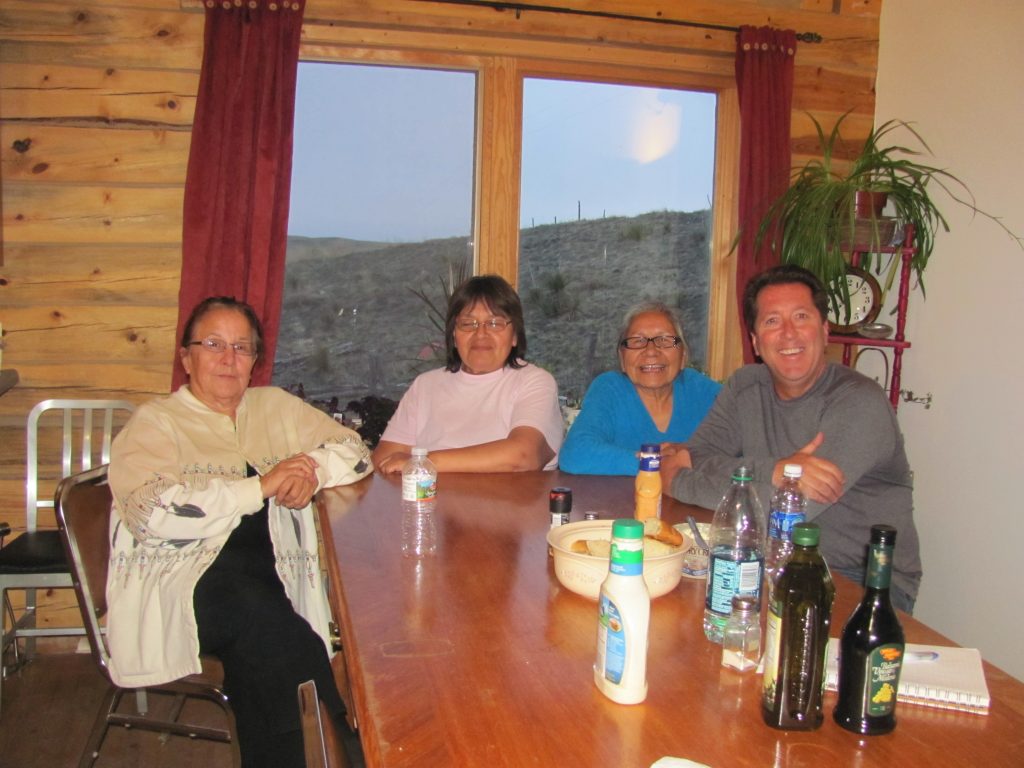
Catherine Grey Day is one of my dearest friends from the Pine Ridge Indian Reservation. To this day she calls me “MISUN” which is the Lakota word for “little brother”. The following is an excerpt from my first book NOT FOR SALE – FINDING CENTER IN THE LAND OF CRAZY HORSE depicting my first deep encounter with her over dinner one night at the Singing Horse Trading Post.
“Tonight I am responsible for cooking the buffalo burgers. Rosie, Catherine, Alina, and I are all in the kitchen. Over dinner, we tell stories and share ideas. The conversation turns to the question of why it seems so hard for the people who live here to break from historic patterns and improve their economic conditions. The topic prompts Catherine to tell the story of the Indian crabs in a bucket:
A white man and an Indian man are collecting crabs by the seashore. They each have a bucket. The Indian fills his bucket quickly and sits down on the rocks to rest. The white man keeps working to fill his bucket, but the crabs crawl out and escape as quickly as he catches them. This goes on for some time. Finally, in frustration, the white man sits down beside the Indian.
‘I can’t seem to fill my bucket. No matter how hard I work, the crabs keep escaping. Why don’t yours escape?’ he says, turning to the Indian.
The Indian replies, ‘Well, you see, the crabs in my bucket are Indian crabs. When one gets ahead, the rest pull him right back.’
Everyone laughs. Catherine has a big smile. Even thought Catherine is an elder, she has the smile of a wide-eyed child.
Catherine continues speaking and in doing so references the phrase ‘internalized oppression’.
‘What do you mean by internalized oppressing Catherine,’ I ask.
‘It’s just about being worn down, generation after generation. The cavalry, the missionaries, the boarding schools – you wake up one day and it has all been internalized. When you have been oppressed over generations and generations, it finally takes hold. The oppression takes hold within you, it is perpetuated from within, and we act out the oppression on ourselves. We perpetuate the oppression on ourselves. That is how deeply it has been ingrained.’
A silence comes over the table. We are all waiting for Catherine to speak again, and after some time, she does.
‘There is a lot of jealousy here – lots of infighting, lots of distrust. Who is more pure-blooded? I think people waste lots of energy on meaningless questions such as this. If we are all related, why does it matter who is truer-blooded?’
There is more silence before Catherine continues.
‘There is lots of waiting here, too. There is lots of waiting on all reservations. I used to live on the Mescalero Apache Reservation and there was a big shortage of housing. Everyone would just apply and wait, apply and wait. You were always waiting. Nothing ever happened; you just waited.’
More time passes.
‘Change comes from within,’ Catherine continues. ‘Our progress as a people must come from within.’
‘I like Pine Ridge though,’ Catherine says with a smile. ‘It is one of the least-colonized places in America. That’s what I like about living here.’
The conversation bounces around. Dinner is always an event here. We have been at the table for well over an hour and no one is in any hurry to see it end.
‘I am always so tired here at night,’ I say shaking my head and yawning.
‘It’s the energy here,’ Catherine replies. ‘The energy here is different than what you are used to. It is more powerful, more pure.’
Silence follows, before Catherine looks right at me and speaks, ‘You were searching for your inner self. That’s why you came here. You were looking for something within you, and you have been able to find it here. Your spirit guides have spoken to you, and you have listened.’
‘I have many spirit guides,’ Catherine continues. ‘There are those I know and some I don’t know. I give the ones I know names. I talk to them. Some people think I am crazy because I talk to them, but that doesn’t bother me. They are with me all the time. They are my friends.’
As dinner winds down, the conversation turns light again.
‘Do you know the Lakota word for vegetarian?’ Catherine asks.
‘No, what is the Lakota word for vegetarian?’ I reply.
‘Lousy hunter’, she answers, and starts laughing.”
