
The following excerpt is the opening scene from my first book, Not for Sale—Finding Center in the Land of Crazy Horse, which chronicles my first six trips to the Pine Ridge Indian Reservation in South Dakota. The story starts with a question: “What brings you here?”
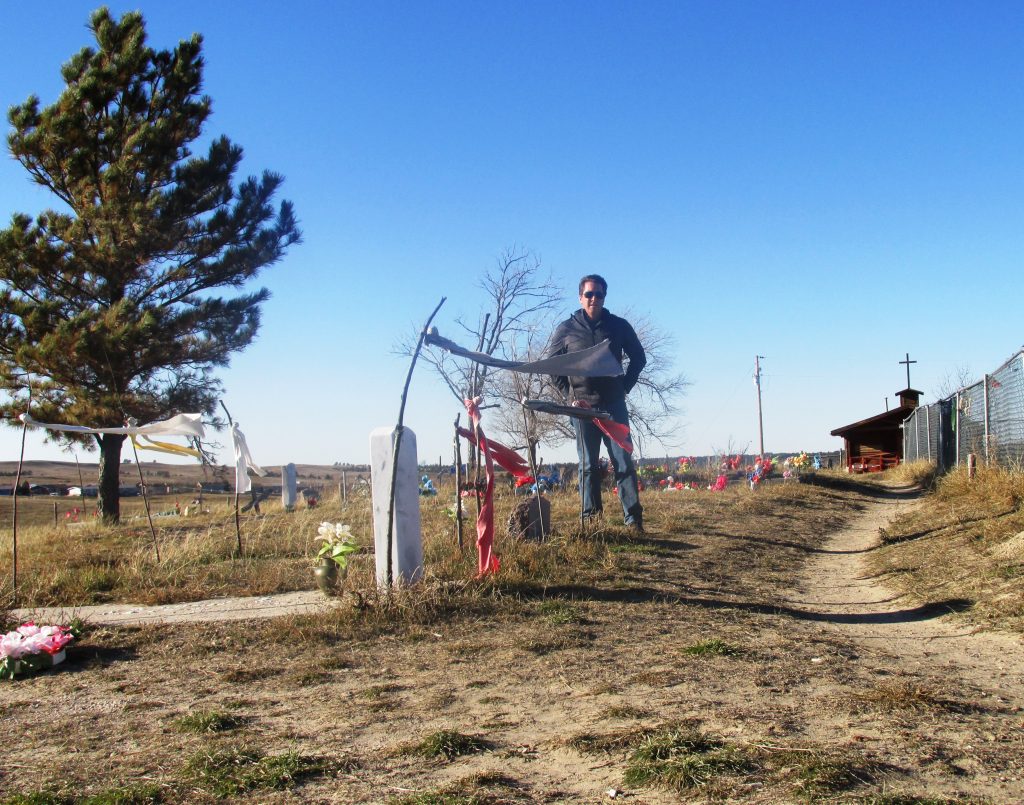
In traveling to Pine Ridge I was stepping way beyond the boundaries of my designated “lane.” In doing so, I was following my own voice—the voice of my heart—in a way that I was only beginning to recognize and understand. Since then, “what brings you here?” has become one of my favorite questions to ask myself at any juncture, moment of joy, or time of challenge in my life. Self-reflection is a pre-requisite for growth and we can always ask ourselves what’s brought us to this moment in our lives.
Anway, here’s the opening passage from the book. Please enjoy!
What Brings You Here?
“The Old West is not a certain place in a certain time; it’s a state of mind. It’s whatever you want it to be.” —Tom Mix
“What brings you here?” the old woman asked me.
Moments ago I had watched her hustle out the front door of her modest home, climb into her car, and pull down the long dusty driveway. She turned onto the highway just long enough to drive right up beside me. She was rolling down the window before the wheels stopped turning.
“I have been visiting Pinky,” was my reply.
“Oh, I know Pinky! She helped me get some insulation for my home last winter,” she says.
“My name is Kevin,” I say, extending my hand into the car.
We shake hands and smile. Then she quickly turns to business. From the empty passenger seat she grabs a small assortment of jewelry and hods it out towards me.
“I made all of these,” she tells me.
She goes on to explain that during the summer she sells her jewelry from the wooden stand strategically located behind the historical marker that I have been reading.
“How much for that one?” I ask.
The necklace I am pointing to is wrapped around rawhide and contains an assortment of white, yellow, black, and red beads. In my short time here, I have already learned that these are the four colors of the Lakota medicine wheel. The medicine wheel itself symbolizes the Six Great Powers (West, North, East, South, Sky, and Earth). In addition, at the center of the wheel, some say a Seventh Power also lives. This is the power of the individual spirit, which is essential to a healthy Lakota society.
Between each string of colored beads is a long brown bead that looks like a seashell. At the bottom of the necklace hangs an eagle’s-head pendant. The eagle is dark brown with streaks of white running from its beak to its neck. The eagle is celebrated in Lakota culture because it soars near the heavens.
“Well, I sell these all summer for thirty dollars. But this is off-season. Nobody travels through here this time of year. This time of year I sell them for twenty dollars,” she explains.
“I really like it. I’ll take it,”I reply.
We exchange a few passing thoughts, a twenty-dollar bill, and a necklace.
“Our people are poor in dollars, but rich in culture,” is her last remark.
She pulls out of the dirt parking area and heads back up the winding driveway toward her humble home. A swirl of dust is pushed out in all directions behind her. Not another car has passed since the front door of her house first opened. I am alone again with the gray sky and shifting winds at the Wounded Knee Massacre Site, on the Pine Ridge Indian Reservation in the southwest corner of South Dakota. In more ways than one, I am a long way from home.
“Finally, some capitalism,” I whisper to myself.
